The little telescope that could
A short review of the ZWO Seestar S30, a smart telescope small enough to take anywhere, after a year and a half with it.

I bought a ZWO Seestar S30 in February 2025. Three days later it had taken a picture of the Orion Nebula, from a rooftop in the middle of Athens. This is a short review after a year and a half with it.
What it is
A telescope, a camera, a motorised mount and a small computer in one white box about the size of a thermos, on a little tripod. It has a 30 mm lens with a 150 mm focal length at f/5, a built-in light-pollution filter, and no eyepiece at all: you drive it from a phone app, and the picture builds up on the phone's screen. The whole thing fits in a small case, which matters more than any of the numbers.
Setting up takes a couple of minutes. You put it down roughly level, tell it what you want to see, and it works out where it is pointing from the stars themselves, slews there and focuses on its own. Then it starts taking ten-second exposures and stacking them, live, so the faint stuff slowly comes out of the noise while you watch.
Where to use it
Like any telescope, it is at its best under a dark sky, away from city lights. Darkness is what deep-sky photography runs on: the darker the sky, the fewer frames you need for the same result, and the more of the faint outer detail of nebulae and galaxies you can pull out. Because it is so small and sets itself up, taking it somewhere dark is easy, and that is how it is meant to be used.
And in the city
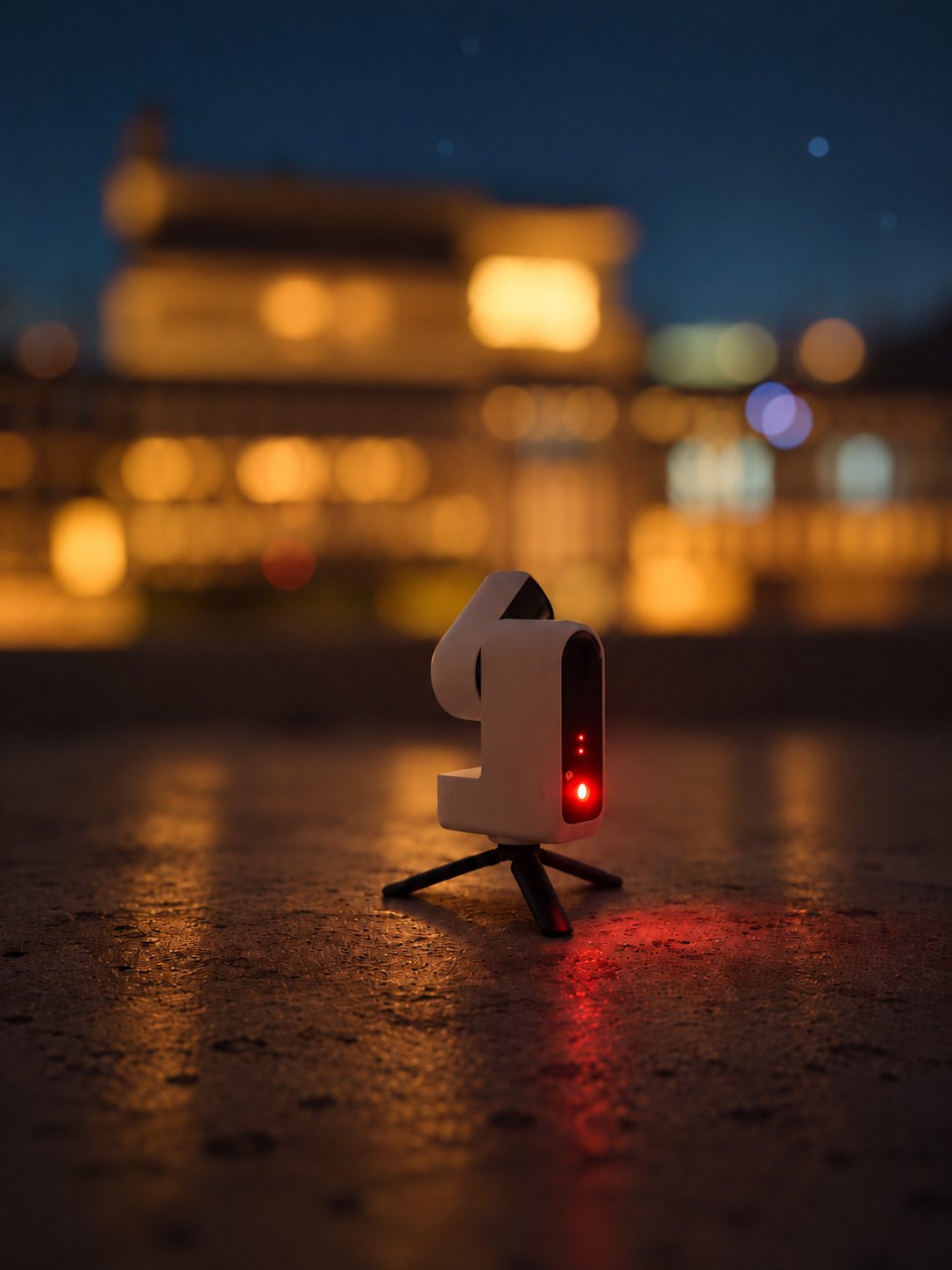
It still works from a city, with limits. Light pollution costs time rather than ruling things out, and it costs the most on the faintest targets. The red emission nebulae cope best, because the filter passes their light and blocks much of the street-light glow: the Orion Nebula on my Night sky page, shot from Athens, is 420 frames, about 70 minutes, and the Monkey Head Nebula is 460.
Galaxies suffer most. Andromeda is mostly starlight, which the filter can't separate from the sky glow, so from the city half an hour of frames still gives a soft result. The Moon doesn't care at all: it is bright enough for a single short exposure anywhere, and it is the best first target there is.
The catches
It is small. The finished images are 1080 × 1920 pixels, fine for a phone and this site, not for a print on the wall.
Out of the box the mount runs in alt-azimuth mode, which follows the sky in two axes, so the frame slowly rotates: exposures stay at ten seconds and the edges of a long stack get ragged. It also has an equatorial mode that removes the rotation, but that needs a wedge or a tilted tripod head and a bit more setup, which takes away some of the grab-and-go appeal.
Doing it yourself
The app stacks and processes everything on its own, and for a quick look that is enough. For the best results, though, I have the Seestar keep every individual frame and do the work myself on a computer: Siril to stack the frames and stretch out the faint detail, then darktable or GIMP for the finishing touches. It takes an evening instead of a button press, and it shows in cleaner backgrounds, richer colour and more of the faint structure.
It is also half the fun. The Seestar makes the capture easy, and processing is where I am actually learning how any of this works.
Not the only one
The S30 is one of a growing family of smart telescopes, and they all work in roughly the same way: an app, automatic setup and live stacking. ZWO makes a bigger sibling, the Seestar S50, whose 50 mm lens gathers more light and frames smaller targets more tightly, and newer Pro versions of both. Dwarflabs makes the DWARF telescopes, even smaller and lighter and built for travel. Vaonis (the Vespera) and Unistellar sit higher up, with bigger and considerably more expensive instruments.
The S30 sits at the small, wide-field end of that range. Its wider view suits big nebulae and the Moon, and it is one of the cheapest ways in. If you mostly want small galaxies, one of the bigger models is worth a look.
Verdict
It is a real telescope that happens to be very easy to use: small enough to take anywhere, quick to set up, and good for a first result on the first night, with plenty of room to grow once you start processing the frames yourself. Take it somewhere dark and it rewards you; keep it on a city roof and it still gives you nebulae and the Moon. It won't replace a big rig, but it doesn't try to: it is a great first telescope for beginners, and just as good for experienced astrophotographers who want something they can carry anywhere and have running in minutes. For anyone curious about the sky, I would recommend it without much hesitation.